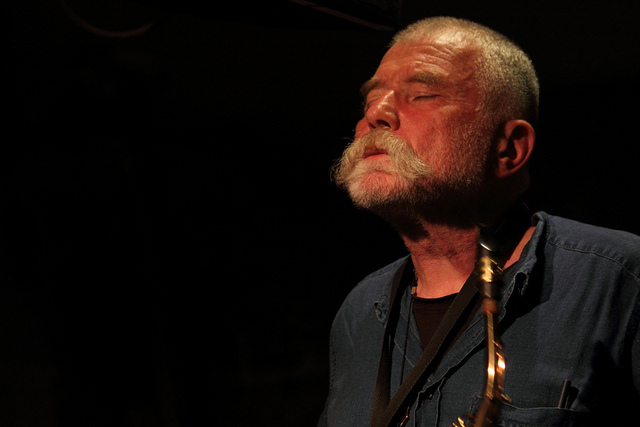
The last time Roscoe Mitchell played London with his cohorts in the legendary Art Ensemble of Chicago, he looked a little frail. At Oto however, he appeared, if not exactly sprightly, certainly full of, well, breath. And breath is key to Mitchell’s music, he’s a master circular breather, supremely adept with numerous reeds and woodwinds, any one of which he could seemingly blow happily for an eternity. And when he steps outside of the more egalitarian context of AEC, it’s even more apparent why he’s been dubbed in some quarters as a ‘super musician’.
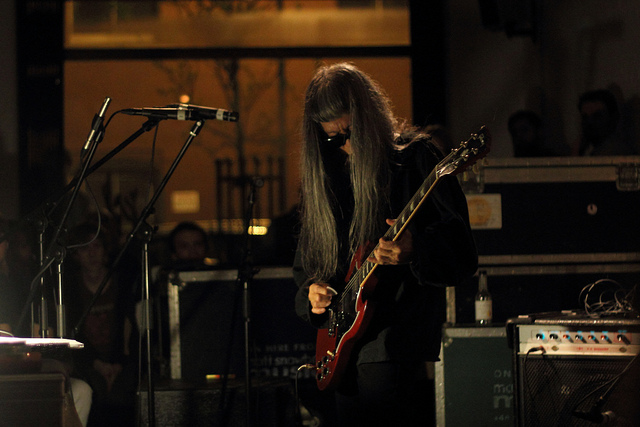
For his two-night residency, Mitchell’s accomplices were drummer Tony Marsh and bassist John Edwards, and even the latter, the junior of the trio by some years, was really put through his paces by the 71-year old saxophonist. Regularly seen vigorously thumping and humping his bass at Oto, Edwards has proved continually that he has more than ample energy and ideas to keep up with any of the most forceful and fiery improvisers, but Mitchell’s extraordinary technique and endless inventive switches made this a real workout.
Warming up, things took on a slow spiritual air as Mitchell began with sustained notes from his alto, Edwards easing himself in with walking bass notes while Marsh (who remained standing for the entirety) filled the spaces with subtle mallet and brush work on toms, snare and cymbals. And suddenly all the tension broke, Marsh finding himself grinning and banging away like a child on his first drum kit as Mitchell launched into the first of several extended runs, eyes and cheeks bulging and contorting, with every muscle above his waist apparently in concentrated spasm. Edwards, possibly realising the futility of trying to keep up, answered the alto’s fluctuating calls with broad and dramatic bow strokes.
Moving to soprano sax, Mitchell became a little less lyrical, forcing raspy timbres in prolonged waves, at one point summoning what sounded like a (huge) swarm of bees. Hands dancing rhythmically but frenetically on the valves, the vision was one of a man so caught in the moment, diligently experimenting and coaxing new patterns and registers but never at the expense of an obvious and palpable passion. Edwards and Marsh for their part provided exceptionally sensitive accompaniment, the former bowing under the bridge while the latter rattled his sticks between between bits of his kit.
Whenever Mitchell sat out (always briefly), he returned to lead his collaborators into long-form improvisations that peaked each time with a tumult of circular breathing and percussive bashing, only to suddenly give way to the sweetest and slowest of melodies. When working with wooden flute, he drew Edwards from light pastoral passages into full-on drone-offs, bringing a thick fog down over proceedings. Marsh topped the ambience off exquisitely, tickling drops from his rack of small string-held cymbals.
Beginning the second set, Mitchell sat blowing delicately through his soprano, gradually forcing more breath through, while Edwards scraped the wooden body of his instrument with his fingers. Paradoxically, when ‘actual’ notes began to appear, things went further out, Marsh’s brushes thumping the sides of his kit and Edwards bowing behind his bridge. Some of the oft-forgotten humour of AEC’s music also came out when Mitchell challenged the pair to respond to a series of unpredictable one and two-note staccato bursts, visibly amusing Marsh as he reacted, scraping skins slowly before insistently slapping down his responses. For the remainder of the set, the exploration continued tirelessly with wails, gallops, rises and falls, and endless, endless breath. When the trio’s every physical and musical muscle was finally exhausted, the applause was long and rapturous, but it was obvious that even the audience were running on reserves by this point.
Photos by Scott McMillan.